Exhibits-Past and Present
Civil War Exhibit
 |
|---|
The Battle of Mine Creek occurred on October 25, 1864, east of Mound City and south of what became the town of Pleasanton. This is the only Civil War battle fought on Kansas soil. Two of General Sterling Price’s Brigadier Generals, James F. Fagan and John S. Marmaduke, and approximately 7000 Confederate soldiers from the Army of Missouri, who were attempting to retreat to Arkansas or Texas, were overtaken by Union forces led by Colonel Frederick Benteen and Colonel John Phillips who were part of Major General Alfred Pleasonton’s Provisional Cavalry Division. Although greatly outnumbered, Union soldiers dealt a devastating blow to the retreating Confederates who were desperately trying to escape across the flooded creek. This battle was one of the largest Cavalry conflicts of the Civil War.
The La Cygne Historical Society is honored to house a few artifacts which were used in the Battle of Mine Creek. Among these are two rifles with bayonets, a sword and a drum.
Home Town Teams
 |  |
|---|---|
 |
Country Schools
 |  |
|---|---|
 |  |
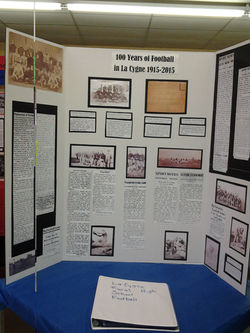
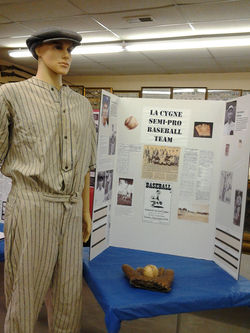
In 2014, the La Cygne Historical Society was awarded a grant from Humanities Kansas. It was a Hometown Team Partner Grant which asked “What Binds Our Community Together? It’s Hometown Teams!” Throughout that year, we investigated how various sports teams and athletic individuals have had an impact on our community. Then we created displays based on our research. In particular, we were celebrating 100 years of football in La Cygne, honoring a man who played on a semi-pro baseball team and remembering the Prairie View state champion football team from 1970.
In addition to these, we showcased two popular coaches from Prairie View: Grady Elder and Daryl Ramsey. We also featured Matt Driskell’s achievements in auto racing, Ty Clearwater’s rodeo accomplishments, Dana Teagarden’s skills as a referee for both men’s and women’s rugby and Muriel Wolfe Prike’s experiences in women’s basketball at the University of Kansas with coach Phog Allen. Numerous other displays were also featured.
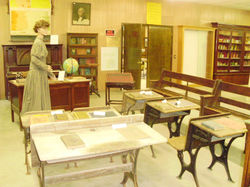
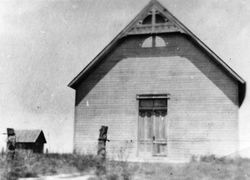
There were 104 school districts in Linn County, but other district numbers were added as some small, rural schools consolidated. The majority of these districts had small, one-room buildings where one teacher instructed all the grades from first grade through eighth grade. Younger students were often paired with older students who would tutor them in some subjects while the teacher worked with other grade levels. At least once a year, the County Superintendent would visit each rural school to see how things were going. At Christmas, the students would present a program for the parents and community members. Another performance might take place at the end of the spring term where students would share their accomplishments during that term.
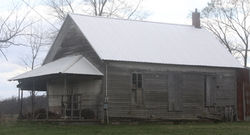
In 2016, the La Cygne Historical Society designed displays featuring all of the rural Linn County schools for which we could find pictures or artifacts. It is amazing how many of these buildings are still standing. Some were converted into homes; others were used as barns. A few became community centers, while a limited number were relocated to historical parks and have been preserved. All that remain of some is the foundation.
We also included a few Miami County schools because students from these schools later attended high school in La Cygne.
Churches-Past and Present
 |  |
|---|---|
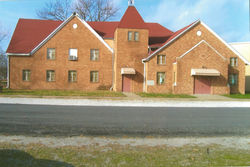 |
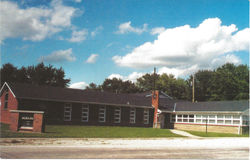
La Cygne was founded in 1869. According to The La Cygne Journal, churches had begun to organize by 1870. The first four groups to do so were the Catholics, the Methodists, the Presbyterians and the Baptists.
In 1870, the Catholic Society constructed a building on Market Street near the office and residence of Dr. T. J. Danner. It was located directly south of where the school was later erected on Walnut Street. However, by 1876, there is no mention of the church in the newspaper. Many years later, the Catholics once again have a church in La Cygne. Our Lady of Lourdes was built in 1982 and is located at 5th and Grand.
According to maps we have at the museum, the Presbyterian Church was located on the southeast corner of 5th and Locust. The cornerstone was laid in June of 1870. Pastor William H. Vroom presented his first message in the newly completed building on Sunday, August 21, 1870. They continued to hold services through 1909. In 1911, the building was put up for bids and Jay Miller had the winning bid, $500. The Journal states that the new Methodist parsonage was built on that location. Dr. A. J. May purchased the bell and presented it to the Methodists in hopes that they would hang it in their new church. The museum has in its collections a Bible which belonged to the Presbyterian Church.
The Methodist Church has had a presence in La Cygne from the very beginning. Their first services were held in a log school house south of La Cygne. Other meetings were held in Heath’s Hall and Cady Hall. During the summer of 1870, a building was constructed on Walnut Street. The first service was held there on November 19, 1870. In January of 1909, they purchased lots from R. M. Carroll on the corner of 4th and Chestnut Streets. The old building was moved to this location, but they later decided to erect a new building. This building was exactly like the building in Drexel, Missouri and the contractor was M. W. Oberton. It was dedicated on April 27, 1924. An addition has been added to the east side of the building. The old building was purchased by C. T. Potter who relocated it to Market Street and converted it into a house. It was torn down to make room for our current Post Office. The museum has several items of memorabilia that was donated by the Burnett family.
Other Methodist churches also played a key role in La Cygne history. In November of 1886, the African American congregation was in the process of constructing a building at the south end of Railroad Street. In 1911, the church burned, so they purchased a building from Jay Miller and moved it to their lots and remodeled it. McCabe Chapel at Jingo also has strong ties to La Cygne. After the church closed, a former member gave a lot of memorabilia that she had saved to the museum.
In June of 1870, a Baptist Society was organized in La Cygne. Their first meetings were held in Cady Hall. They secured lots on 4th Street across from S. D. Cady’s residence for a church building. Rev. Albert Gore became their first minister. The group continued to meet in Cady Hall through the end of 1871 and even purchased an organ. Plans to build a brick building in 1872 never came to fruition. In the fall of 1883, there were once again plans to organize a Baptist Church. This did not materialize until July of 1886 when the First Baptist Church applied for a charter and Rev. C. J. Plumb became pastor. At first, the Second Baptist Church allowed them to use their building until they rented T. W. Williamson’s store building on the north side of Market Street in August of 1886. They are first called the Calvary Baptist Church in March of 1888 and Rev. John Sage became their pastor. Their first building was erected on the southeast corner of Locust and Broadway. In 1957 their current chapel was completed on the northeast corner directly across from the old building. An addition was added in the 1980’s. The museum has two chairs which are from the church.
There are two other Baptist churches that have played important roles in La Cygne. The Second Baptist Church was very active, organizing a choir, hosting socials and concerts and performing many baptisms. A 26 x 30 frame structure was built in the southern part of town on Vine Street in 1880 and Rev. E. M. Cohran was their first pastor. They were also known as the Mount Pilgrim Baptist Church. In April of 1988, another church, the New Life Baptist Church, was established in La Cygne. They held their first meetings at the La Cygne Elementary School, but later rented the church at Jingo. When they built their own building, they used windows, doors, bricks and wood trim from the old elementary school building. The church is located on the east side of town next to the current medical building.
The La Cygne Christian Aid Society was formed in April of 1894. A building was erected and on January 20, 1895 the La Cygne Christian Church was dedicated. Between 1946 and 1950, fundraising efforts, and the adoption of the “God’s Acre Plan” resulted in the construction of a new building which was dedicated on November 18, 1951. A multi-purpose building was added in 2000. Structural problems with the main building resulted in it being demolished in January of 2007. Currently, the multi-purpose building houses the sanctuary, a kitchen, restrooms and classrooms.
The Four Square Church also had a presence in La Cygne. Their building was located at the northeast corner of Chestnut and Broadway. The building is still standing and has housed several businesses, including Coach's Pizza, Pudgy's Bakery, a video rental store, a flea market and others.
The Streets of La Cygne
 |  |
|---|---|
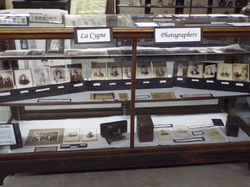 |  |
During 2018, our featured exhibit was called "The Streets of La Cygne. The museum has numerous photos and artifacts from the many businesses which once lined the streets of the town. Since 2019 was our sesquicentennial, we extended the display so our visitors for La Cygne 150 could enjoy all these treasures. Many of these displays have become permanent features of the museum. A popular attraction was the Sanborn Fire Prevention Maps of early days in La Cygne. They show where the buildings were, what type of material they were made from and where all the sources of water were located. One activity we sponsored during the celebration was trolley tours through the town hosted by historian, Johnnye Ann Lane.
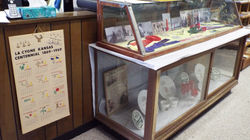
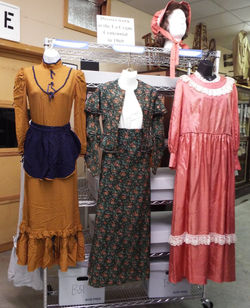
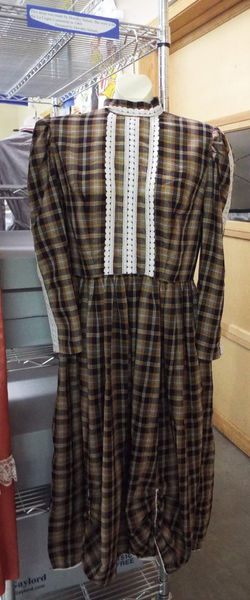
La Cygne Centennial
 |  |
|---|---|
 |  |
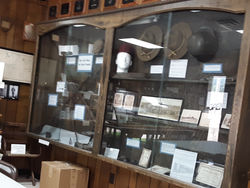
The Military Room of Honor
 |  |
|---|---|
 |  |
 |
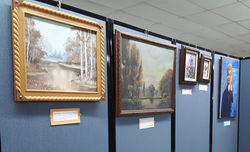
Paintings By Local Artists
 |  |
|---|---|
 |  |
 |  |
The 1970's
 One of the standpipes erected in the 1970's when Rural Water District #3 brought water to homes west of La Cygne. |  John Teagarden installing the park sign with his daughters, Amy and Dana. |
|---|---|
 Sign made by Don Lutton. He said if he hadn’t run out of black paint, he would have put the second M in swimming. | 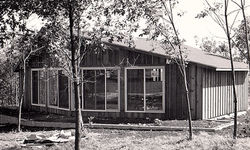 The first house built in Tanglewood. |
 On September 1, 1978, Dr. Robert Kotch established a private practice at the La Cygne Clinic. |  Museum display about the KCPL power plant east of La Cygne. |
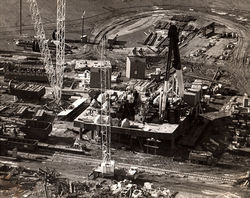 Construction on the KCPL power plant in the 1970's. |  Jack Lindsey & Paul Creager, co-chairmen of the museum building committee, with Chet Boswell who made the sign. |
Antique Quilts
 This primrose path quilt was made by Anna Black Hutchins to raise funds for the construction of the American Legion Building in La Cygne. It resides at the Kansas Historical Museum in Topeka, but we were fortunate to be able to borrow it for our display. |  Alladene Johnston helped embroider the quilt she is standing beside. It was made to raise funds for the La Cygne Historical Society. |
|---|---|
 This double wedding ring quilt was made by Ida Weickert in 1930. |  This baby quilt is made using the six-pointed star pattern. |
 This crazy quilt was made around 1896 and has the names McKinley and Hobart on it. It also has the words "Stand Up For Kansas" embroidered on it. | 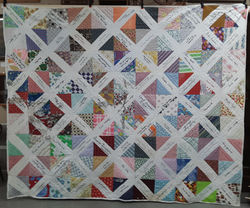 This signature quilt was made by the Linn County Senior Citizens, Christmas of 1975 and given to Jean Allen. |
 The quilt, in the pine cone pattern, was made by Tennessee Agnes Shelton, put together by her granddaughter, Elizabeth Ross, and hand quilted by Julia Croghan. | 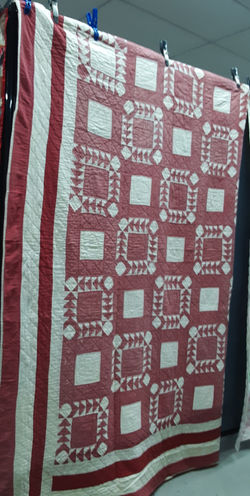 This flying geese quilt was salvaged from the home of Harrison Oberton by Norma Long before the house was demolished. She cleaned it up and donated it to the museum. |
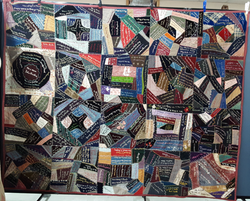 This crazy quilt was made by the Ladies Aide in the 96 neighborhood to raise money for the 96 Cemetery. It was purchased by Charley Miller and given to his daughter, Cleda Miller Patterson, who later donated it to the museum. | 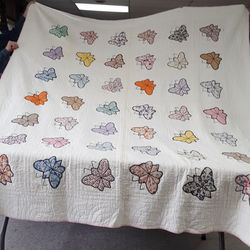 This butterfly quilt was made by Ida Weickert in 1933. |